The Science of ADHD Task Paralysis and Attentional Perseveration
Why can an ADHD brain hyperfocus on a complex hobby for four hours straight, yet physically freeze for three days over a chore that takes 90 seconds? The truth is, the human brain doesn’t measure task difficulty in minutes, it measures it in dopamine, executive bandwidth, and cognitive set-shifting costs. From the neurochemical gating of the mesoaccumbens reward pathway to the working memory overload of the “micro-decision trap,” the ADHD “freeze” isn’t a lack of willpower; it’s a biological system mismatch.
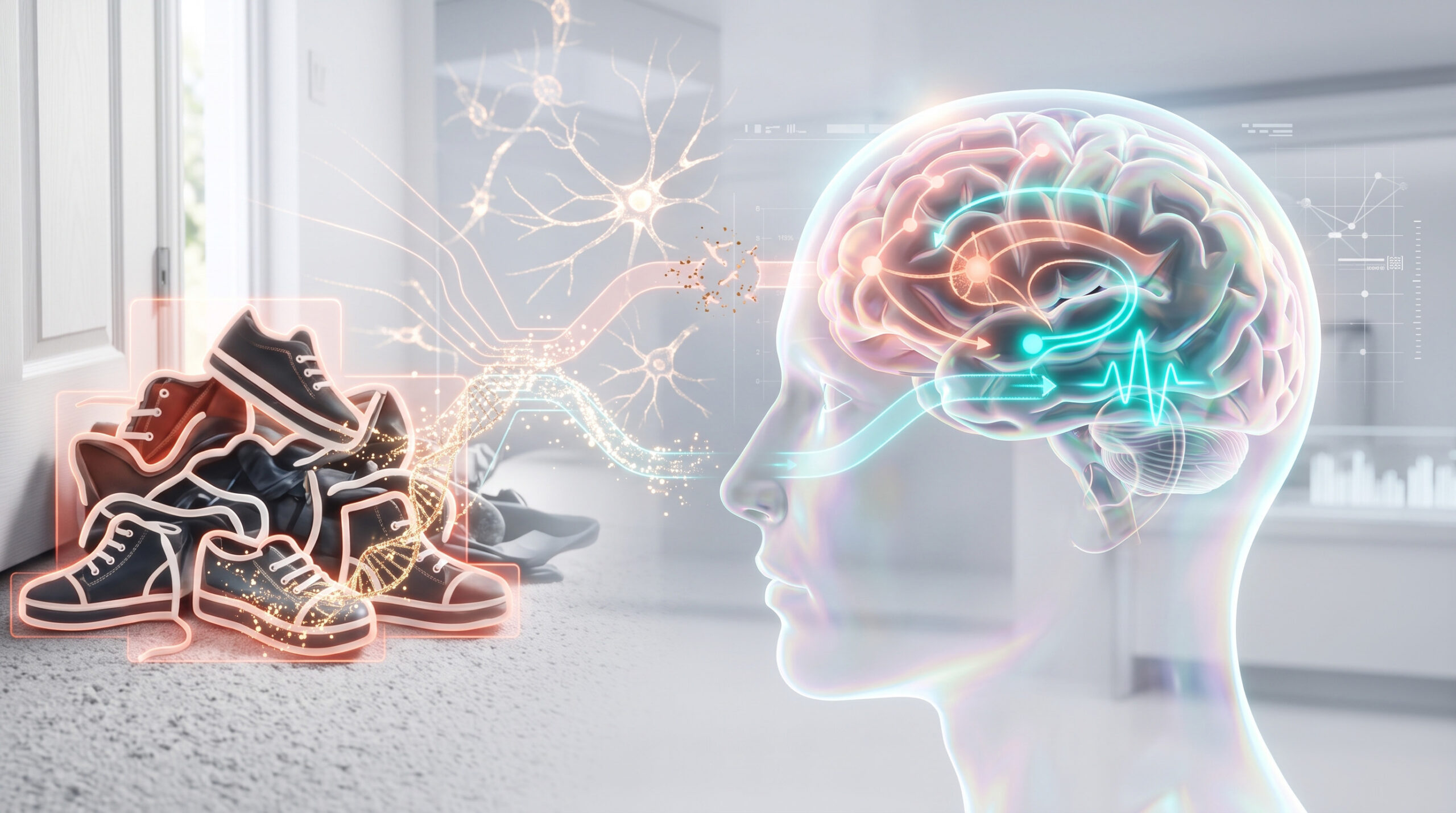
If you spend enough time around neurodevelopmental literature or neurodiversity forums, you will inevitably encounter a baffling contradiction: an individual who can hyperfocus for four uninterrupted hours assembling intricate mechanics, writing code, or creating digital art, yet remains physically immobilized for three days over putting away a pair of shoes.
To the uninitiated, and frequently to exasperated partners, parents, and managers, this operational asymmetry looks like blatant defiance, selective effort, or poor self-discipline.
Before you assume this is an issue of willpower, we need to examine the underlying neurobiology. The human brain does not calculate the cost of a task in clock minutes; it evaluates it through neurochemical gating, working memory limits, and frontostriatal network activation. When viewed through the lens of receptor density and executive function modeling, what appears to be behavioral avoidance is actually a predictable, involuntary system freeze.
1. The Biological Gating Problem
The mesolimbic and mesocortical dopamine pathways serve as the brain’s valuation and activation switchboards. Dopamine signaling does not simply register pleasure; it generates incentive salience, the neurochemical signal that tags an upcoming action as worth pursuing and recruits motor networks to initiate physical movement.
In a neurotypical nervous system, steady baseline (tonic) dopamine levels maintain a functional signal-to-noise ratio within frontostriatal circuits. This ambient tone allows the prefrontal cortex to bridge the temporal gap between present effort and future reward, providing enough endogenous drive to execute mundane, low-salience tasks. In an attention-deficit/hyperactivity disorder (ADHD) brain, this baseline signaling is profoundly dysregulated.
Receptor and Transporter Deficits: In a landmark positron emission tomography (PET) study published in JAMA, Dr. Nora Volkow and colleagues evaluated dopamine synaptic markers in never-medicated adults with ADHD. Using radioligands targeting dopamine $\text{D}_2/\text{D}_3$ receptors and presynaptic dopamine transporters (DAT), the researchers demonstrated marked reductions of both markers within the mesoaccumbens reward pathway—specifically in the nucleus accumbens, caudate, and midbrain. Receptor availability in the accumbens was directly correlated with objective ratings of attention.
The Ignition Threshold: Because the ventral striatum exhibits lower baseline receptor and transporter availability, mundane activities (such as sorting laundry or washing a cup) fail to stimulate the pathway. Without sufficient baseline dopamine, the frontostriatal circuit fails to send the necessary activation command to premotor and motor regions. The brain hits an operational standstill before physical movement can begin.
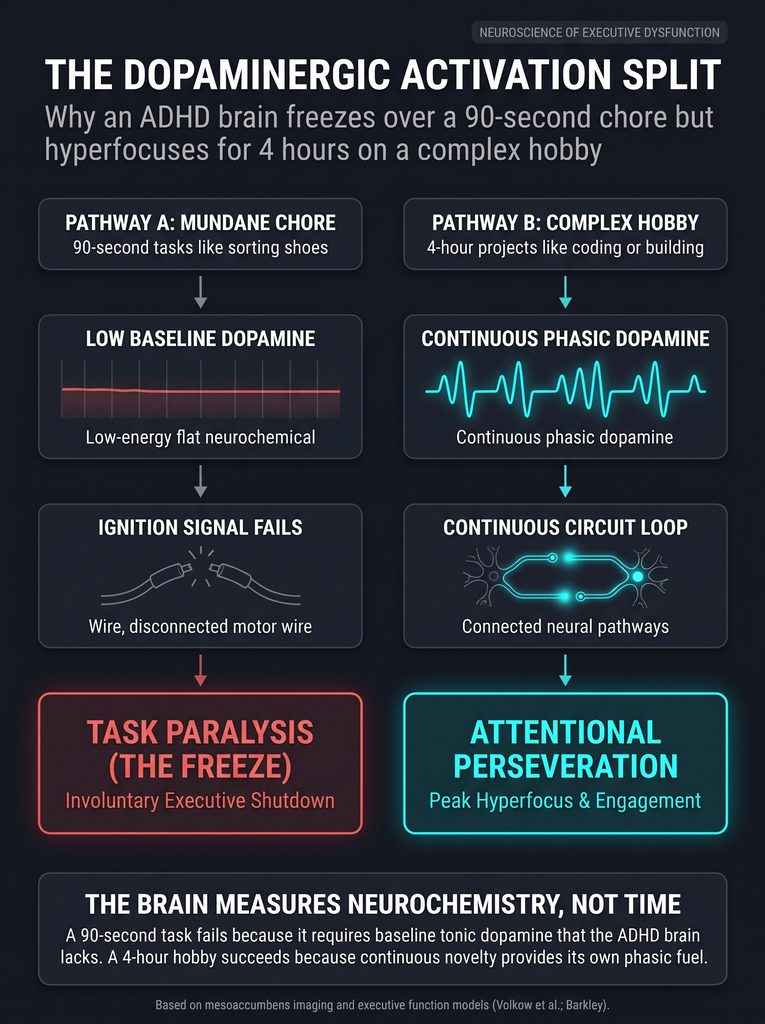
The Phasic Dopamine Rescue: The ability to sustain hours of focus on a complex hobby relies on a separate mechanism: phasic dopamine firing. Intricate hobbies deliver continuous novelty, rapid problem-solving, tactile feedback, and closed-loop progress indicators. Each resolved sub-problem triggers a sharp phasic dopamine burst. This transient flood temporarily bypasses baseline deficits, bathing the striatum in the neurochemistry required for deep alertness and cognitive persistence.
2. Attentional Perseveration and the Cost of Shifting Gears
The popular term “hyperfocus” suggests a heightened, supercharged state of voluntary concentration. In clinical neuropsychology, however, this phenomenon is recognized as attentional perseveration, an inability to flexibly disengage and reallocate processing resources.
Dr. Russell Barkley’s unifying model of ADHD demonstrates that the disorder’s primary defect lies in behavioral inhibition. Behavioral inhibition provides the cognitive braking power required to interrupt ongoing behavior, evaluate temporal horizons, and switch mental sets.
- Backward Inhibition Failure: Shifting from a high-dopamine activity to a low-dopamine chore is not a neutral transition; it carries a massive metabolic switching cost. When an ADHD brain attempts to pivot away from an engaging task, the active cognitive schema resists suppression. The neural transmission is essentially stuck in a high-engagement gear, unable to downshift smoothly.
- Time Blindness: Barkley emphasizes that ADHD impairs non-verbal working memory, which in turn degrades the brain’s internal clock. The temporal horizon contracts, dividing reality into two distinct perceptual categories: Now and Not Now. An engaging hobby operates entirely in the sensory Now. A 90-second chore belongs to the abstract Not Now until an external deadline creates acute crisis.
3. Working Memory Saturation and the Micro-Decision Trap
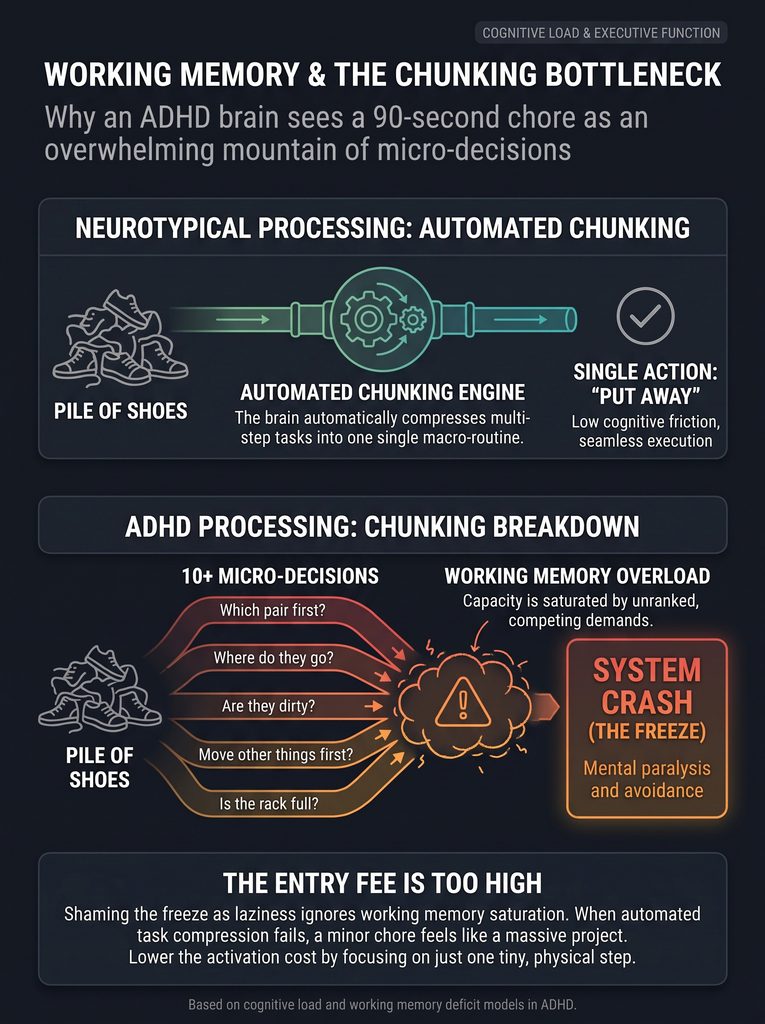
To a neurotypical individual, the directive to “put away the shoes” is processed as a single, low-effort cognitive unit. The brain relies on automated cognitive chunking to compile a complex motor sequence into an integrated macro-routine.
In an ADHD brain, working memory capacity is significantly restricted. Because automated chunking fails to compress sequential steps, a mundane domestic chore fragments into a chaotic sequence of unranked micro-decisions:
- Which pair do I pick up first?
- Where do these belong relative to seasonal footwear?
- Are the soles dirty enough to require cleaning before storage?
- The shoe rack is full—do I need to reorganize the entire closet first?
When each sub-decision demands conscious deliberation, the volume of data rapidly exceeds working memory bandwidth. The central executive experiences processing saturation, triggering a cognitive shutdown.
The Three Phenotypes of ADHD Paralysis
In clinical practice, executive freeze manifests in three primary presentations:
| Phenotype | Underlying Mechanism | Behavioral Manifestation | Scaffolding Intervention |
| Task Paralysis | Striatal initiation failure secondary to tonic hypodopaminergia. | Physical immobility; feeling glued to the spot despite conscious intent. | Radical scope reduction; reducing the task to an irreducible physical micro-action. |
| Choice Paralysis (Analysis Paralysis) | Working memory saturation driven by unweighted decision trees. | Over-deliberation; endless cycling through minor variables; fear of poor choices. | Eliminating branches; establishing rigid binary rules and pre-set boundaries. |
| Mental Paralysis | Central executive saturation from sensory or emotional flooding. | Brain fog; cognitive blankness; passive behavioral withdrawal. | Somatic resetting; tactile unburdening; external sensory reduction. |
The Biological Penalty of Shame
When an observer attempts to motivate an ADHD brain by declaring, “Why are you avoiding this? It literally takes two minutes!”, it triggers an acute threat response. The subjective friction of a task is dictated by executive load, not duration. Weaponizing time introduces evaluation anxiety, activating the amygdala and extended stress networks. As cortisol and adrenaline flood the system, cortical perfusion drops, worsening the executive dysfunction that generated the freeze in the first place.
4. Biology vs. Heuristic
Psychiatrist Dr. William Dodson coined the term Interest-Based Nervous System to characterize how ADHD motivation diverges from traditional expectations.
Modern institutions assume an importance-based operational model: individuals are expected to engage with tasks because they are consequential, assigned by authority, or linked to delayed rewards. For an ADHD brain, importance alone fails to activate frontostriatal networks. Dodson identified four primary situational catalysts that unlock prefrontal activation, formalized as ICNU (or expanded into the coaching mnemonic PINCH: Passion, Interest, Novelty, Challenge, Hurry):
- Interest: Tasks providing intrinsic intellectual fascination.
- Challenge: Framing routines around mastery, speed records, or competitive play.
- Novelty: Changing tools, locations, or operational approaches.
- Urgency: Imminent deadlines carrying clear, non-negotiable consequences.
The Danger of Urgency-Driven Living
While the interest-based nervous system is a clinical heuristic rather than a distinct neuroanatomical classification, its components map to known biological pathways. Interest and Novelty recruit the ventral striatal dopamine pathways directly. Urgency and Hurry, however, exploit an entirely separate system: the locus coeruleus-norepinephrine (LC-NE) network and the sympathoadrenal stress axis.
When an unstimulating task is delayed until panic sets in, the surge of central norepinephrine forces cortical activation through sympathetic arousal. While this emergency override can jump-start task completion, relying on urgency as a primary productivity strategy causes persistent autonomic dysregulation, limbic sensitization, and clinical burnout.
5. Why Willpower Fails (And Evidence-Based Interventions)
Because task initiation failure is driven by chemical and computational deficits, attempts to “try harder” are structurally inefficient. Effective intervention requires modifying the task environment to lower activation thresholds and externalize executive function.
- Radical Scope Reduction (The Irreducible First Step): Rather than instructing the brain to execute an abstract chore (e.g., “tidy the floor”), reduce the command to an irreducible physical movement (e.g., “pick up one blue sock”). A single physical motion places virtually zero demand on working memory. Completing that movement generates an immediate sensory milestone, producing a small phasic dopamine signal that reduces friction for subsequent actions.
- Acoustic Modulation and Stochastic Resonance: Sydney Zentall’s Optimal Stimulation Theory demonstrates that ADHD symptoms often represent homeostatic attempts to counteract a chronically under-aroused central nervous system. Introducing supplementary auditory stimulation (fast-paced playlists, podcasts, or structured rhythms) provides the baseline cortical arousal required to sustain task engagement.
Furthermore, Sikström and Söderlund’s Moderate Brain Arousal (MBA) model proves that moderate auditory noise induces stochastic resonance in hypodopaminergic neural networks. The external noise adds random variance to baseline neural activity, raising weak, sub-threshold cognitive signals across the action-potential threshold without disrupting data processing. - Body Doubling and Social Scaffolding: Working alongside an individual who is focused on their own independent work acts as an externalized executive anchor. Grounded in experimental social psychology (Norman Triplett’s co-action effect and Robert Zajonc’s social facilitation theory), the mere presence of another person elevates generalized arousal, enhancing efficiency on routine tasks. Concurrently, the non-evaluative presence provides autonomic co-regulation, neutralizing the threat response often provoked by aversive tasks.
- Closed “Good Enough” Heuristics: Open-ended goals invite working memory loops and choice paralysis. Pre-decide rigid operational parameters before starting: “I will clear items off this desk for exactly four minutes, and anything left over goes into a sorting bin”. Removing real-time evaluation closes the branching pathways that trigger executive freezes.
The Verdict
The paradox of ADHD task paralysis is neither an ethical failure nor an inexplicable behavioral contradiction. It is the direct neurobiological result of reduced baseline $\text{D}_2/\text{D}_3$ receptor and DAT availability in the mesoaccumbens reward pathway, constrained working memory capacity, and impaired behavioral set-shifting.
An ADHD brain can hyperfocus for hours because continuous, complex problem-solving provides the steady stream of phasic dopamine required to sustain cortical networks. Conversely, mundane 90-second chores generate negligible anticipatory signaling, leaving the central nervous system without the chemical drive needed to initiate physical motion. Relying on shame, duration-based lecturing, and chronic panic worsens executive collapse. Sustainable productivity requires lowering activation energy through micro-stepping, utilizing acoustic stimulation to induce stochastic resonance, and using external scaffolds like body doubling to bridge the gap between intention and action.
Key Takeaways
- Deficient Baseline Dopamine: PET neuroimaging documents significantly lower dopamine $\text{D}_2/\text{D}_3$ receptor and transporter availability in the nucleus accumbens and midbrain of non-medicated adults with ADHD.
- Tonic vs. Phasic Disconnect: Mundane chores fail to engage the hypodopaminergic system; intricate hobbies trigger repetitive phasic dopamine bursts, temporarily rescuing the reward circuit and causing attentional perseveration.
- Working Memory Saturation: Constrained working memory prevents automated cognitive chunking, causing simple chores to fragment into chaotic cascades of unranked micro-decisions.
- Perseveration Over Flexibility: The cognitive cost of switching gears from high-salience tasks to zero-salience routines is steep due to impaired behavioral inhibition and backward inhibition failure.
- The Cost of Urgency: The interest-based nervous system responds reliably to urgency, but relying on adrenergic stress cascades to initiate tasks increases vulnerability to systemic burnout.
- Evidence-Based Scaffolding: Executive initiation failure is managed by stripping tasks down to single physical micro-steps, deploying acoustic stimulation to induce stochastic resonance, and implementing body doubling for autonomic co-regulation.
FAQ
Is ADHD task paralysis considered an official psychiatric diagnosis?
No. ADHD paralysis is a descriptive clinical and community term rather than a formal diagnosis in the Diagnostic and Statistical Manual of Mental Disorders (DSM-5). However, the underlying mechanisms—task initiation failure, working memory saturation, and executive dysfunction—are well-documented diagnostic features of ADHD.
Why does hyperfocus occur if ADHD is classified as an attention deficit?
ADHD is an impairment of attentional regulation and behavioral inhibition, not an absolute absence of attention. Clinically termed attentional perseveration, hyperfocus occurs when a task continuously supplies immediate novelty, feedback, and reward. This triggers high-amplitude phasic dopamine release, locking the brain into the activity and making it difficult to shift attention to secondary obligations.
Why does saying “it only takes two minutes” make task paralysis worse?
Task friction in ADHD is governed by executive demand and dopaminergic gating, not clock time. Pointing out how brief a chore is introduces moral evaluation and frustration. The resulting shame triggers a sympathetic stress response, activating the amygdala and further impairing prefrontal executive function.
Can background music or white noise genuinely improve task initiation?
Yes. Under Sydney Zentall’s Optimal Stimulation Theory, ADHD brains are chronically under-aroused and seek external stimulation to reach baseline homeostasis. Additionally, Sikström and Söderlund’s Moderate Brain Arousal model shows that unstructured acoustic noise produces stochastic resonance, lifting sub-threshold cognitive signals over the action potential firing barrier in hypodopaminergic frontostriatal networks.