CBL-514 is the new weight-loss drug
CBL-514 started as an injection for stubborn fat, but it’s now showing up in real metabolic research. It targets a protein called DYRK1B, the first drug ever to do so, and helps shrink the dangerous fat that builds up around your organs. Unlike some other fat-loss drugs, it works by triggering fat cells to die off cleanly rather than just shrinking them. Early findings suggest it could also help people who’ve gained weight back after stopping GLP-1 drugs like Semaglutide or Tirzepatide.

How CBL-514 is moving from body contouring to the frontlines of obesity science
With injectable therapies dominating health headlines, every emerging compound that touches adipose tissue gets swept into the weight-loss conversation. For years, the investigational drug CBL-514 was strictly categorized as a localized, cosmetic “fat-melting” injection, an aesthetic tool designed to smooth out stubborn subcutaneous pockets rather than alter metabolic health.
Presentations at the European Association for the Study of Diabetes (EASD) Annual Meeting have transformed that narrative.New clinical data demonstrate that CBL-514 not only clears superficial body fat, but also significantly reduces deep, dangerous visceral adipose tissue (VAT), and may even hold the key to solving post-GLP-1 weight rebound.
This comprehensive breakdown covers what CBL-514 is, how its unique cellular mechanism works, and why its role in modern obesity pharmacotherapy is undergoing a major evolution.
1. What’s in a Name? Deciphering “CBL-514”
“CBL-514” is an internal developmental code designation, not a marketed brand or an approved generic name.
Before an investigational therapy completes Phase 3 trials and receives formal FDA approval, it operates under an alphanumeric research code. Only after passing key regulatory milestones does a compound receive an official United States Adopted Name (USAN) nonproprietary generic name and a commercial trade name.
Two important distinctions clarify its identity:
- The Developer Origin:The “CBL” prefix reflects its developer, Caliway Biopharmaceuticals, an international clinical-stage biotech company advancing the molecule through formal FDA-registered trials (not an unauthorized compounding pharmacy mixing off-label formulas).
- No Relation to Cancer Targets: In oncology, researchers frequently discuss CBL-B inhibitors (which target the Casitas B-lineage lymphoma family of E3 ligases). Despite the matching letters, CBL-514 is an entirely unrelated chemical entity targeting metabolic and adipose tissue pathways.
2. The cellular mechanism: DYRK1B inhibition and apoptosis
Unlike older injectable lipolytics, CBL-514 is a first-in-class, small-molecule DYRK1B kinase inhibitor.Its primary biological mechanism is inducing adipocyte apoptosis—programmed cell death—directly in targeted fat cells.
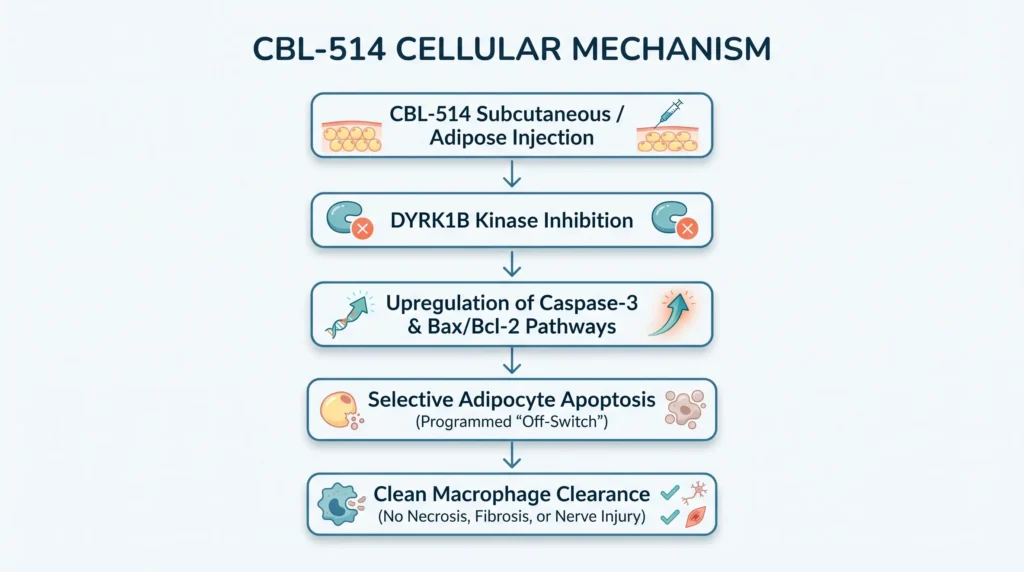
In human tissue, fat cells can be destroyed in two distinct ways:
- Necrosis (Accidental Cell Death): The cell membrane bursts, spilling toxic intracellular contents into surrounding tissue. This triggers extreme inflammation, severe swelling, bruising, and risks permanent damage to surrounding dermal nerves and microvessels (the primary drawback of older agents like deoxycholic acid).
- Apoptosis (Programmed Cell Death): The cell receives an internal biochemical signal to quietly dismantle itself, condensing into membrane-bound fragments. Specialized immune cells (macrophages) then sweep in and metabolize the cellular remnants through normal pathways, leaving adjacent nerves, skin, and vascular structures completely intact.
By inhibiting DYRK1B, CBL-514 upregulates pro-apoptotic mediators (caspase-3 and the Bax/Bcl-2 ratio).This causes targeted adipocytes to permanently self-destruct while leaving surrounding non-adipose cells untouched.
3. Moving beyond subcutaneous fat to visceral fat
For most of its development, CBL-514 was evaluated primarily as an aesthetic treatment for abdominal subcutaneous fat (the pinchable layer directly beneath the skin). In Phase 2 trials, it repeatedly showed strong cosmetic efficacy, reducing localized abdominal fat volume by 20% to 25% on ultrasound and MRI with minimal downtime.
Clinical readouts presented at the EASD conference by clinical investigator Dr. W. Timothy Garvey and Caliway changed how researchers view the compound:
- Significant Visceral Fat Reduction:In Phase 2 MRI sub-analyses (studies CBL-0204 and CBL-0205), CBL-514 demonstrated an average 12% reduction in L2–L3 visceral adipose tissue (VAT) within 4 weeks of treatment, compared to a 5.7% increase in the placebo group (treatment difference: -94.9 mL, p = 0.0015).
- Why Visceral Fat Matters:Unlike subcutaneous fat, visceral fat wraps around internal abdominal organs (the liver, pancreas, and intestines).It is biologically active and secretes inflammatory cytokines that directly drive insulin resistance, type 2 diabetes, hepatic steatosis (fatty liver), and cardiometabolic disease.
Achieving a non-surgical, direct pharmaceutical reduction of visceral fat without systemic gastrointestinal side effects shifts CBL-514 from a purely cosmetic contouring agent to an investigational candidate in cardiometabolic and obesity pharmacotherapy.
4. Solving the “GLP-1 rebound”: the tirzepatide combination data
One of the greatest challenges in modern obesity medicine is weight regain. Incretin-based therapies like semaglutide (Wegovy) and tirzepatide (Zepbound) dramatically reduce body mass by curbing appetite and slowing gastric motility. However, they primarily shrink the lipid volume stored within existing adipocytes rather than eliminating the cells themselves. When patients stop taking GLP-1s, their appetite returns, and those surviving fat cells rapidly replenish, triggering the notorious yo-yo rebound.
Research presented at EASD and the American Diabetes Association (ADA) highlighted a compelling synergistic strategy:
- Augmented Weight Loss:In preclinical models, combining CBL-514 with tirzepatide produced significantly greater fat loss and body-weight reduction than tirzepatide monotherapy.
- Attenuated Weight Regain:When tirzepatide was discontinued in animal studies, subjects that had received concurrent CBL-514 regained substantially less weight than those on the GLP-1 therapy alone.
Because CBL-514 induces apoptosis, it permanently eliminates the structural storage units (adipocytes).With fewer fat cells available to reaccumulate triglycerides, the biological capacity to regain fat mass post-treatment is fundamentally diminished.
5. CBL-514 vs. Kybella vs. Incretin mimetics
| Clinical Feature | CBL-514 (Investigational) | Deoxycholic Acid (Kybella) | Incretin Mimetics (Semaglutide / Tirzepatide) |
| Primary Class | DYRK1B kinase inhibitor / Lipolytic | Non-selective bile acid detergent (Cytolytic) | GLP-1 / GIP receptor agonists |
| Primary Route | Subcutaneous micro-injections | Subcutaneous micro-injections | Weekly subcutaneous injection (systemic) |
| Primary Indications | Abdominal fat, Dercum disease, emerging VAT/obesity adjunct | Submental “double chin” fat only | Chronic weight management, type 2 diabetes, cardiovascular risk |
| Mechanism of Action | Selective Apoptosis (programmed cell death) | Tissue Necrosis (cell membrane rupture) | Central appetite suppression & delayed gastric emptying |
| Adipose Target | Subcutaneous & deep Visceral Adipose Tissue (VAT) | Superficial subcutaneous fat only | Whole-body fat stores (systemic lipid deflation) |
| Post-Treatment Rebound Risk | Low (adipocytes are permanently destroyed) | Low (localized destruction) | High (adipocytes re-expand rapidly upon drug cessation) |
| Primary Side Effects | Mild, temporary injection-site swelling, erythema, tenderness | Severe swelling, injection-site pain, risk of marginal mandibular nerve injury | Nausea, vomiting, diarrhea, muscle loss, gastroparesis |
6. Fast track for Dercum’s disease
Beyond body contouring and metabolic obesity trials, CBL-514 has made substantial progress in orphan disease management.
Dercum’s disease (adiposis dolorosa) is a debilitating condition characterized by multiple, intensely painful subcutaneous lipomas (fat tumors) that compress surrounding peripheral nerves. Standard treatment has historically relied on surgical excision or liposuction, which carries significant operative risks, leaves extensive scarring, and suffers from high rates of tumor recurrence.
In clinical trials, direct micro-injection of CBL-514 into painful lipomas produced significant volumetric reductions while markedly lowering patient pain scores. Recognizing the critical unmet need, the FDA granted CBL-514 Fast Track designation, opening an expedited regulatory review pipeline for this medical indication.
CBL-514 is evolving past its initial reputation as a simple cosmetic alternative to liposuction. While global Phase 3 trials continue to evaluate its performance for non-invasive abdominal contouring, its newly verified ability to reduce visceral fat and prevent post-GLP-1 rebound positions it as a promising dual-threat therapy in both aesthetic medicine and metabolic disease.
Key takeaways
- Mechanism Over Destruction: CBL-514 is a small-molecule DYRK1B kinase inhibitor that triggers apoptosis (programmed cell death) rather than necrosis (rupturing cell walls), preventing tissue damage and nerve injury.
- The Visceral Fat Breakthrough: Recent Phase 2 MRI data presented at EASD showed an average 12% reduction in L2–L3 visceral fat, shifting the compound from a cosmetic body-contouring shot to a potential cardiometabolic therapy.
- Mitigating the Post-GLP-1 Rebound: While GLP-1s shrink fat cell size, CBL-514 permanently removes the adipocytes. Preclinical combination studies indicate it helps prevent rapid fat replenishment after incretin therapy stops.
- Orphan Disease Status: It holds FDA Fast Track designation for reducing painful subcutaneous lipomas in Dercum’s disease.
FAQ
Is CBL-514 currently approved by the FDA?
No. CBL-514 is an investigational drug designation. It is actively advancing through Phase 2 and Phase 3 clinical trials and has not yet received commercial marketing approval from the FDA or international regulatory bodies.
How does CBL-514 differ from Kybella (deoxycholic acid)?
Kybella relies on deoxycholic acid, a cytolytic agent that causes tissue necrosis (rupturing cell membranes indiscriminately), which often leads to severe swelling, tissue inflammation, and risk of localized nerve injury. CBL-514 selectively triggers apoptosis (natural programmed cell death) exclusively in fat cells, allowing macrophages to clear the debris cleanly without injuring adjacent nerves, blood vessels, or skin layers.
Will CBL-514 replace GLP-1 medications like Wegovy or Zepbound?
It is not designed to replace them. GLP-1 agonists operate centrally to control appetite, delay gastric emptying, and induce large-scale whole-body weight loss. CBL-514 acts directly on fat tissue at the cellular level. Researchers are studying it as a complementary therapy—both to sculpt localized areas and to prevent the common weight-regain rebound seen when patients discontinue incretin medications.
How is the treatment administered in clinical trials?
It is delivered via an in-office grid of subcutaneous micro-injections directly into targeted adipose tissue (such as the abdominal wall or painful lipomas), typically administered over two to four sessions spaced several weeks apart.